Supercharger Install!
What a long strange trip it’s been...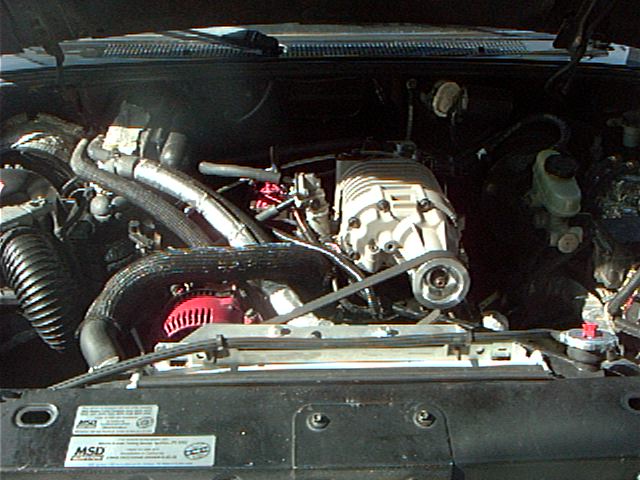
Gen 1 "Frankencharger" - this is a pretty rough way to start.
Quick Time Movie Windows Media Player Movie
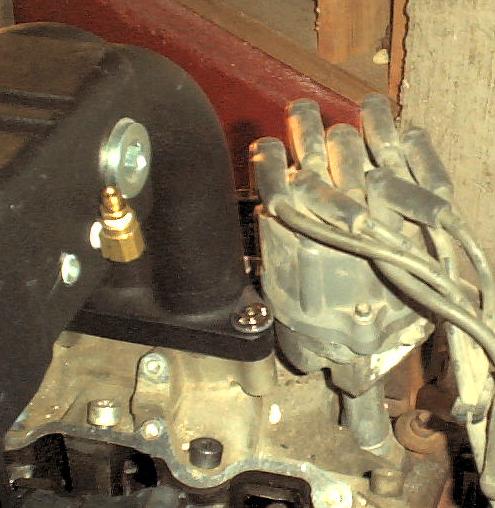
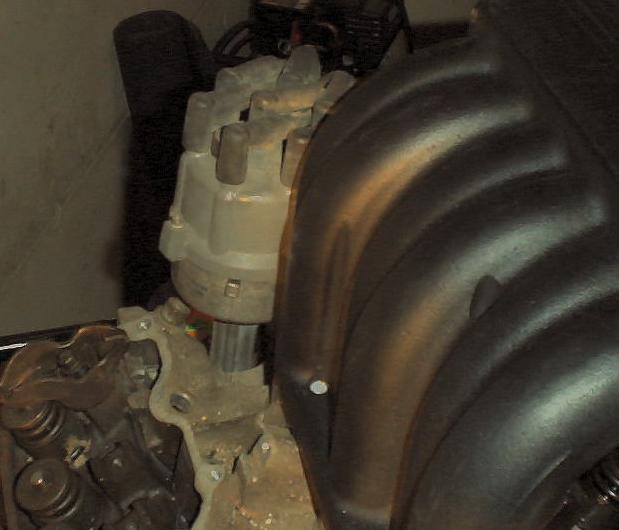
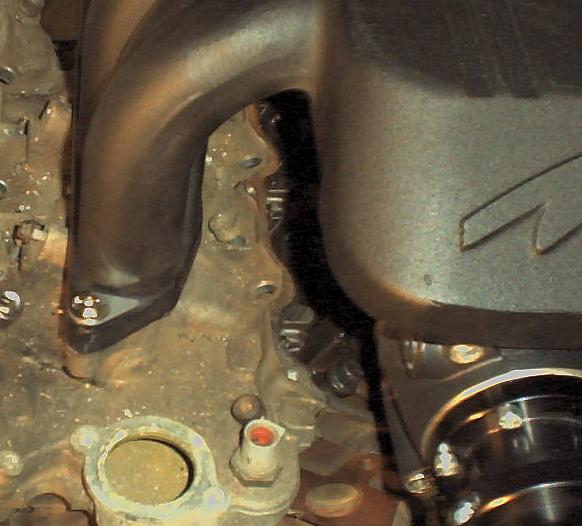
Truck is being lowered 3" (remove body lift) before ported and polished heads and Whipple
are installed. Work started 23 May 2005 on the Whipple install - notice the trick self-locking fasteners!
Well, I bought a supercharger "kit" a year ago that was suppose to be a "bolt on". No such luck. To make a long story short, the person/business is a hack, it didn’t fit, didn’t work and had to be redone from scratch. Deal with people face to face, ensure they understand that quality is key and you will accept nothing less.
This is going to cover my recommendations (and secrets) on how you can do this, mostly, yourself. Any install like this is going to be deemed "custom" or "one-off", and therefore is going to cost $$$ unless you can do some/most of it yourself.
I HIGHLY encourage EVERYONE to get the Whipple kit that was released late ’03 (No longer available), it was part of the Ford Racing Catalog in ’03/’04. If you own a Pre-2002 Ranger (or don’t wish to modify the brand new SC kit), here is what you need and why:
- Throttle Body - 1994/95 Mustang or Cobra, it is 65mm and has the TPS and IAC on the same side
- Sensors from YOUR 3.0L (TPS, IAT, IAC), solves all hook up/compatibility issues
- Your choice of supercharger (GM3800 Series II, Eaton Gen IV, Whipple recommended), must be no less than
62CI/1,000cc/1L in size (5-6lbs boost), but 90CI/1,500cc/1.5L is preferred for higher boost numbers.
- 1080K6 Belt (or whatever size you ultimately need)
- Fuel Enrichment Plan (see text)
- Timing Plan (see Text)
- Enhanced Cooling system (Pre-’98)
- Any 3.0L upper intake, but not the one on the vehicle now!
- A K6 style pulley that will achieve the desired blower speed
- Patience
Contact your local welder/machine shop. Any local shop can do the plenum, it’s really basic.
Ideally, you would have access to a CnC mill so you could make a two piece system that has all the manifold Allen head bolts neatly hidden inside the plenum, but if not, try this:
Using your OTHER intake manifold (any year, any vehicle), mill ½" off the bottom of the upper intake to allow clearance for the nuts that will be used on the front and rear studs. Then measure and cut the top off ¼" above the valve covers and/or wiring harness (for clearance). Make a box set off to the driver-side so it clears the FPR/Schrader valve, this is the base for your supercharger and your serves as a plenum. Lay the SC on top while the manifold is bolted down to eyeball/mark it for the mounting holes. Then use the lower SC gasket as a pattern for making the boost holes, etc.
Things to remember:
IAT is 3/8"NPT, have a hole in the plenum for this, it will remove timing as the plenum temperature rises!
Make an access plate on the driver-side for a high quality oil cooler to be used as a water to air heat exchanger (inter-cooler), or use the Nitrous Express (NX) Ntercooler. Make holes in the front and rear to be plugged for future use; temperature sensors, water injections sprayers, Nitrous Oxide, etc.
Here are some secrets:
Check your local area for trade schools or Job Corps. They have machining/welding students that need new ideas/projects for their grade, and the instructors supervise them practically the whole way. You pay for only materials (and possibly a slight mark up)! If you have multiple companies working on small parts at the same time, it not only gets done quicker and, there is less chance of it being held hostage (to hold out for more money). Make sure they know that you are PROTOTYPING a system for possible sale, they may knock the price down to recoup their layout charges over a run of parts vice up front.
Supercharger math:
OK, the next question is what charger to use...
What do you want to build? If you would be happy with a stock, bolt on set up and 5-7lbs boost is plenty, then the Eaton M62 (Series I GM3800) is fine. This supercharger takes in 1L of air per revolution and has a 14,000 RPM red-line. He is the math:
First, what is the pulley ratio? Crank pulley diameter/Blower pulley diameter
The ’94 Ranger with a 3.0L engine has a 5.825" crank pulley and I currently have a 2.75" blower pulley for 5.825/2.75=2.12:1 ratio
This means the supercharger turns 2.12 times for each turn of the crank. At 5,800 RPM, the charger would be spinning at 12,296 RPMs, plenty of safety margin. Now, a 3.0L engine can inhale 306CFM of air (Cubic Inches*RPM/3464), and the charger is putting out 12,296 LPM (Blower RPM*Capacity) which converts to 434.17 CFM (LPM*0.03531). We compute boost as "CFM excess" or 434.17-306=128.17CFM excess. To get boost numbers, the CFM excess is used to figure the ratio (Boosted CFM/normal CFM) and multiplied by 14.7 to reference it to atmospheric pressure. Now we take (128.17/306)/14.7 and we get 6.15lbs of boost (at sea level without any loss due to heat, atmospheric pressure or temperature). An M90, which moves 1.5L per rev and redlines at 12,000 using a 2:1 ratio (2.9" pulley) would net 15lbs of boost!
Boost theory and myths:
If I have a supercharger on my truck, at 4,000ft altitude, and I make 3 lbs of boost, we can take that same charger, bolt it on to a bone stock Ranger at sea level, showing 7lbs of boost and, I could trounce him in a race.
Why? Simple, at ~4,000ft the supercharger, turning at a fixed rate because it is belt driven from the crank, takes in less air than at sea level and, I have lower manifold boost numbers. I also show lower boost because I have made many breathing mods. Most blower ads say "Increase HP 55%", and people think that is on top of what they have modified their vehicle to, not factory HP. Sorry to say this, but more HP means you can freely move more air, so a heavily modified engine will see lower boost numbers AND not reach that magic 55% as advertised because the blower moves the same amount of air, regardless of how beefy your engine is. Got it?
So, that poor sap who who is bragging about his 7psi [at sea level] is sporting the factory 150 Crankshaft HP + the 55% HP increase from the supercharger for a total of 232.5hp. He is going to get creamed when I meet him at the track with my "pathetic" 4-5lbs boost (1-2psi higher since I dropped 4,000ft altitude) with my 180 modified Crankshaft HP + 40% HP (lower increase due to the higher CFM flow of the modified engine) or 252HP.
Boost is relative. Relative to the CFM capabilities of the particular vehicle, relative to the ambient air conditions, and relative to altitude. The more restrictive and engine is, the higher the boost numbers associated with that engine. Now, does that mean that a turbo running 21lbs of boost is very restrictive? No, it just means that he has a large enough displacement device to fill his engine with 21lbs of excess air pressure.
Hence the issue: Molecules of air and their density.
Cold air has a higher density of air molecules than hot air.
Low altitude has higher density of air molecules than high altitudes.
If air is forced through a balloon with a tiny pin prick of a hole in it, the balloon will inflate quickly in relation to the amount of air going in, the inflation of the balloon represents boost. This is just like a restrictive (stock) engine getting a supercharger.
Take the same balloon and make the hole ½in (because you bolted on headers, a high flow cat and a 2½" cat-back exhaust system), now the air coming in is the same (since you did not change the blower pulleys, TB or altitude) and the balloon does not fill up as quick, or as far, the air escaping through the larger hole prevents this. You are producing more HP (as evident by the higher volume of "exhaust" gases), but you now have lower boost numbers.
If this air is not heated while it is being compressed (a violation of the laws of physics!), it would maintain it’s density, and would give you more HP. But, we know that the compression process alone makes heat just because the molecules are bouncing off each other when they are being squished. Add an inter-cooler that isn’t restrictive enough to cause a major pressure drop due to it’s internal flow, and it becomes tougher to fill the engine because the dense air packs nicely in to the cylinders, and your boost drops. But now, your HP goes through the roof because you have cool dense air in those cylinders and a major HP increase can be realized through increased SC speeds and increased timing.
Now, you may be thinking that boost numbers are useless. Well, not quite.
They can tell us how much heat we are generating, how much the blower pulley swap helped, if we are getting any improvement in flow with a new breathing modification, when it is time to change headgaskets (or if you need to "O"-ring the block/heads!), and many other useful things. Just don’t try to compare one persons boost numbers with someone else’s. It doesn’t always work.
This site and its contents are protected by U.S. Copyright Law for unpublished works. Unpublished anonymous and
pseudonymous works, and works made for hire (corporate authorship) are protected for 120 years from date of creation (FEB 6, 2001).
All articles and photos are the property of Rogue Group, LLC (or as marked) and may only be used with written permission.
Site updated 27SEP2010
This page verified with IE8/IE8 Private Browser/Chrome 6.0.472.63/FireFox 3.6.8/e-Capsule™ Private Browser 2.1.0.526
(WA UBI/DUNS/FFL Number available upon request)
